 National Safe Work Month 2026
National Safe Work Month 2026: Practical Resources to Help Your Workplace Get Involved
Explore practical National Safe Work Month 2026 resources to help your workplace start useful safety conversations and turn awareness into action.
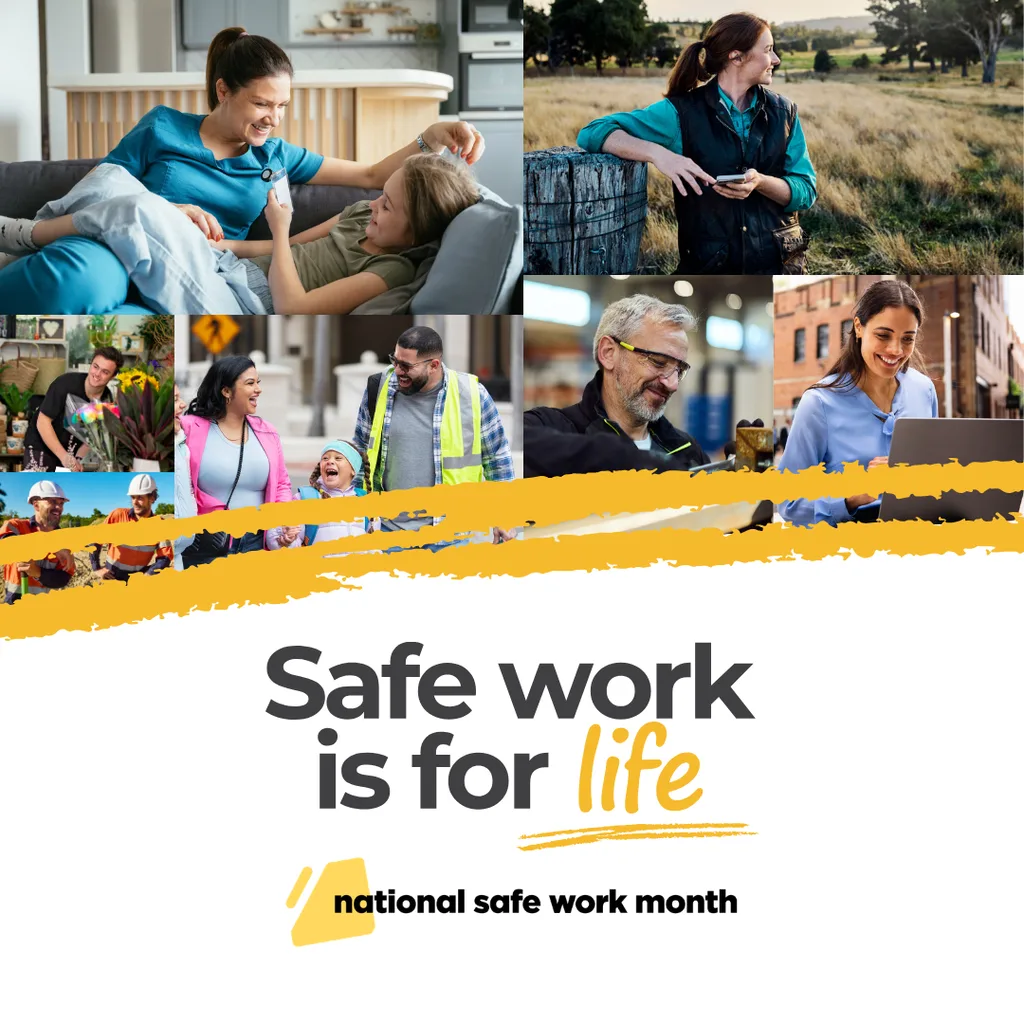
Every October, National Safe Work Month gives Australian workplaces an opportunity to refocus attention on one of the most important responsibilities any organisation has: protecting the health, safety and wellbeing of its people.
For some organisations, October means running toolbox talks, safety stand-downs or training sessions. For others, it may mean reviewing risks, refreshing internal communications, launching a new safety initiative or simply creating more space for employees to talk openly about what is working well and what could be improved.
Whatever approach your organisation takes, the most important thing is that Safe Work Month leads to useful conversations and practical action.
This year’s theme from Safe Work Australia is:
Safe work is for life
It is a simple message, but an important one.
Work health and safety is not only about preventing an incident during today’s shift.
The way work is designed, managed and performed can affect workers immediately, but it can also influence their health years or even decades into the future.
Exposure to hazardous substances may not result in symptoms straight away.
Poorly designed manual tasks can gradually contribute to musculoskeletal injuries.
Psychosocial hazards can have cumulative effects over time.
And when an injury or illness does occur, the way a workplace responds can have a significant influence on recovery and a worker’s ability to return to safe and sustainable work.
That broader view of workplace health is reflected in Safe Work Australia’s four National Safe Work Month focus areas:
Four focus areas for safer work
For life
why work health and safety matters
For health
what work health and safety protects
For the future
the long-term impact
For all
action across all workplaces
These themes provide a useful framework for organisations thinking about how they can participate in Safe Work Month.
But getting involved does not mean you need to develop a completely new WHS campaign from scratch.
Across Australia, Safe Work Australia and state and territory regulators have already developed a substantial collection of practical resources, guides, checklists, activities and tools that workplaces can use.
Throughout National Safe Work Month, we are highlighting some of those resources that we think are particularly useful for employers, WHS professionals, people leaders and anyone responsible for protecting the health of workers.
Here are some worth exploring.
1. Start with the National Safe Work Month Campaign Kit
If you are planning how your organisation will recognise Safe Work Month, the National Safe Work Month 2026 Campaign Kit is one of the easiest places to start.
Safe Work Australia has already developed a range of campaign materials that workplaces can use throughout October.
These include resources designed for both digital and physical workplace environments, allowing organisations to promote Safe Work Month through channels such as:
- workplace noticeboards
- internal newsletters
- staff emails
- intranets
- digital workplace screens
- toolbox meetings
- team meetings
- workplace events
- social media
Selected campaign materials can also be customised using available Canva templates, making it easier for workplaces to adapt the messaging for their own workforce, industry or internal communications.
For smaller organisations in particular, this removes a lot of the work involved in creating an internal campaign.
For larger organisations, it can provide a consistent foundation that individual sites, departments or locations can build upon.
One simple approach could be to use the four weekly themes as the structure for your internal communications throughout the month.
For example:
Week 1 – For life
Ask employees why safe work matters to them personally.
Week 2 – For health
Highlight a workplace health risk that deserves greater attention.
Week 3 – For the future
Discuss how decisions made today can affect workers over the longer term.
Week 4 – For all
Focus on consultation and the role every person plays in creating safer work.
Safe Work Month does not necessarily need to involve a major event.
Sometimes simply creating a consistent conversation throughout October can be enough to encourage people to stop, think and raise issues that may otherwise remain unnoticed.
2. Use the Activity Kit to turn awareness into conversation
Campaign posters can help raise awareness.
But conversations are where Safe Work Month can start becoming genuinely useful.
Safe Work Australia’s 2026 National Safe Work Month Activity Kit provides organisations with practical activities, videos and discussion prompts that can be incorporated into existing workplace routines.
That is particularly valuable because Safe Work Month does not have to sit separately from normal operations.
Activities can be incorporated into:
- toolbox talks
- pre-start meetings
- team meetings
- health and safety committee meetings
- leadership meetings
- training sessions
- site meetings
- informal team discussions
That makes participation more achievable for organisations where taking large groups of workers away from operational duties is difficult.
A short conversation at the beginning of a shift can still be meaningful.
For example, a team might spend ten minutes discussing:
What part of our work creates the greatest risk?
What has changed in the way we work over the past 12 months?
Is there a task we all accept as difficult or uncomfortable simply because “that’s how it has always been done”?
Are there hazards employees have learned to work around rather than actually fixing?
Questions like these can reveal important information.
Workers often experience the practical realities of a task differently from the way it appears in a procedure, risk assessment or office-based review.
That is why Safe Work Month activities can be particularly valuable when they encourage employees to talk openly about the work they actually perform.
One good conversation can uncover a hazard.
One observation can identify a poorly designed task.
One suggestion from a worker can sometimes lead to a relatively simple change that reduces risk for an entire team.
3. Review whether your health monitoring arrangements are appropriate
Some workplace health risks are immediately obvious.
Others are much harder to see.
Workers exposed to certain hazardous chemicals or substances may not develop noticeable symptoms straight away, which is one reason health monitoring plays such an important role in occupational health.
Where required, health monitoring can help detect changes in a worker’s health that may be associated with workplace exposure.
Safe Work Australia maintains an extensive Health Monitoring Resource Hub containing guidance for PCBUs, workers and registered medical practitioners.
The available resources cover exposure to substances including:
- crystalline silica
- asbestos
- lead
- chromium
- isocyanates
- nickel
- arsenic
- cadmium
- mercury
- organophosphate pesticides
- and other hazardous chemicals
For employers, Safe Work Month provides a useful trigger to review whether health monitoring arrangements remain appropriate.
Some questions worth considering include:
What hazardous substances are workers exposed to?
Do we clearly understand which workers are potentially exposed?
Have our work processes, materials or equipment changed?
Are there regulatory health monitoring requirements that apply?
Are workers being monitored at the required intervals?
Do we have processes for responding to health monitoring results?
Are health monitoring records being managed appropriately?
It is also important to remember what health monitoring is not.
Health monitoring should never be treated as the primary control for hazardous exposure.
The first priority remains eliminating or minimising exposure so far as reasonably practicable.
Health monitoring sits alongside those controls as a way of protecting workers and identifying potential health effects as early as possible.
For organisations operating across multiple sites or jurisdictions, maintaining consistency can also become challenging.
Different workers may perform similar roles but have different levels of exposure depending on equipment, environment, duration, processes or local controls.
Safe Work Month can therefore be a useful point in the year to step back and ask whether your occupational health program still reflects the reality of the work being performed.
4. Prepare for the new Workplace Exposure Limits
This year there is another particularly timely reason for organisations to review occupational exposure risks.
From 1 December 2026, Australia will transition from Workplace Exposure Standards to Workplace Exposure Limits for airborne contaminants.
For organisations where workers may be exposed to dusts, fumes, gases, vapours or mists, this is an important change.
Airborne contaminants can be generated across a wide range of industries and work activities.
Examples can include:
- mining and quarrying
- construction
- manufacturing
- welding and fabrication
- transport and logistics
- demolition
- automotive work
- chemical handling
- painting and coating
- maintenance activities
- working with silica-containing materials
- diesel-powered equipment
The move to Workplace Exposure Limits is not simply a terminology update.
Changes affect a number of contaminant listings, exposure limits and advisory notations.
That means workplaces should understand whether any substances used or generated within their operations are affected by the new limits.
October presents a timely opportunity to begin asking some important questions.
What airborne contaminants are present?
Consider both products intentionally brought into the workplace and contaminants generated through work processes.
Dust generated during cutting, grinding or crushing is one example.
Welding fumes, diesel emissions and vapours generated through chemical use are others.
Do we understand worker exposure?
The presence of a contaminant does not automatically tell you the level of risk.
Factors such as concentration, duration, frequency, work environment and existing controls all influence exposure.
Are existing controls still appropriate?
Workplaces should review whether current controls continue to minimise exposure effectively.
This may involve examining ventilation, isolation, substitution, work processes, personal protective equipment or other controls.
Is air monitoring required?
In some circumstances, air monitoring can help organisations understand the level of worker exposure and whether applicable limits are being met.
Does health monitoring apply?
For certain hazardous chemicals and exposures, health monitoring requirements may also apply.
Safe Work Australia has developed dedicated resources to help workplaces understand and prepare for the transition.
For organisations managing occupational hygiene and health surveillance programs, the lead-up to 1 December is an opportunity to ensure systems, controls and monitoring arrangements are ready.
5. Take another look at hazardous manual tasks
Manual handling is often discussed in workplaces as though it is primarily a question of lifting technique.
But hazardous manual tasks are much broader than that.
Work can become hazardous when it involves factors such as:
- repetitive movement
- repetitive or sustained force
- high or sudden force
- sustained or awkward posture
- exposure to vibration
The risk can also be influenced by the design of the task, the workplace, equipment, workflow and environment.
That means reducing musculoskeletal injury risk usually requires more than reminding workers to “lift with their knees”.
Workplace Health and Safety Queensland maintains an extensive collection of Hazardous Manual Task Resources designed to help workplaces better understand and manage these risks.
The resources include:
- manual task risk management worksheets
- hazardous manual task system self-assessment tools
- training guidance
- manual task risk register examples
- slips, trips and falls assessment tools
- practical information for preventing sprains and strains
The collection also includes resources supporting PErforM – Participative Ergonomics for Manual Tasks.
The participative aspect is particularly important.
Workers performing a task every day often know where the physical demands, awkward movements and inefficiencies exist.
They may already know which equipment is difficult to use.
They may know which part of a process creates unnecessary double-handling.
They may know which task causes discomfort at the end of every shift.
Bringing workers into the risk assessment and problem-solving process can help organisations identify practical solutions that may otherwise be overlooked.
During Safe Work Month, consider choosing one commonly performed manual task and watching how it is actually completed.
Ask:
Where is the physical effort occurring?
What movements are being repeated?
Where are workers reaching, twisting or bending?
Could equipment, layout or workflow be changed?
Could the task be eliminated or redesigned entirely?
That exercise alone may identify useful opportunities for improvement.
6. Remember that not every workplace hazard is physical
Safe Work Month is also an opportunity to recognise that work health and safety extends beyond physical hazards.
Workplaces must also identify and manage risks to psychological health.
Psychosocial hazards can arise from the way work is designed, organised, managed and experienced.
They may include issues such as:
- excessive job demands
- low job control
- poor support
- lack of role clarity
- poor organisational change management
- inadequate recognition and reward
- remote or isolated work
- exposure to traumatic events
- violence and aggression
- bullying
- harassment
- conflict
- poor workplace relationships
Importantly, managing psychosocial risks is not the same as running a wellbeing program.
Fruit bowls, meditation apps and employee assistance programs may have a role in supporting wellbeing, but they do not replace the need to identify and control psychosocial hazards within the work itself.
Safe Work Australia’s psychosocial hazards resources bring together practical information covering areas including:
- managing psychosocial hazards at work
- workplace violence and aggression
- sexual and gender-based harassment
- online abuse
- worker consultation
- case studies and practical examples
There is also a Model Code of Practice: Managing psychosocial hazards at work, which provides practical guidance for PCBUs.
Safe Work Month can be a useful time to ask:
Do our leaders understand what psychosocial hazards are?
Do workers know how to raise concerns?
Are we looking at the design of work, or only responding after someone becomes unwell?
Are managers equipped to identify emerging risks?
Do we consult workers when work design, workload or organisational change may affect them?
The goal is not to remove every source of pressure from work.
Many jobs naturally involve deadlines, demanding tasks or periods of increased workload.
The important question is whether psychosocial hazards are being identified and the associated risks managed appropriately.
7. Make consultation part of the way you manage safety
The people performing the work are often one of the most valuable sources of information about workplace risk.
They see what happens when procedures meet reality.
They know which tasks regularly create problems.
They notice when equipment is difficult to use.
They know when production pressures are influencing behaviour.
They experience the practical impact of changes to staffing, systems and processes.
That is why consultation is such an important part of effective work health and safety management.
Safe Work Australia provides a range of consultation resources to support workplaces, including:
- consultation checklists
- worker representation and participation guidance
- health and safety committee information
- practical guidance for PCBUs
- information about consultation, cooperation and coordination
Effective consultation is not simply telling employees what has already been decided.
It means giving workers a reasonable opportunity to:
- share their views
- raise health and safety concerns
- contribute information
- participate in discussions
- understand the outcomes of consultation
Safe Work Month provides a useful reason to look at how consultation happens within your organisation.
Does consultation only occur when a formal risk assessment is completed?
Or is it embedded into day-to-day operations?
Are workers comfortable raising concerns?
Do supervisors actively ask for feedback?
Are health and safety representatives involved appropriately?
Do workers hear what happened after they raised an issue?
Consultation becomes much more powerful when employees can see that speaking up leads to consideration and, where appropriate, action.
8. Think about what happens after an injury or illness
Much of work health and safety is rightly focused on prevention.
But even in organisations with strong systems and controls, injuries and illnesses can still occur.
What happens next matters.
A workplace’s response can influence a worker’s recovery, their confidence, their connection with the workplace and their ability to return to sustainable employment.
Workplace rehabilitation and return to work therefore form an important part of the broader workplace health picture.
Successful return to work often requires coordination between multiple parties, including:
- the worker
- their employer
- their supervisor
- the insurer
- treating health professionals
- rehabilitation providers
- workplace rehabilitation coordinators
- other relevant stakeholders
Clear communication between those parties can make a significant difference.
So can identifying appropriate suitable duties, understanding functional capacity and maintaining appropriate connection between the worker and workplace.
Workplace Health and Safety Queensland provides practical rehabilitation and return-to-work resources, including material relating to mental injury and the return-to-work journey.
Safe Work Month is a good time for employers to ask:
If somebody was injured tomorrow, would our managers know what to do?
Do workers know who they should contact?
Do we have clear processes for identifying suitable duties?
Are supervisors confident communicating with injured workers?
Do we have a process for managing more complex cases?
Are we proactive, or do we wait until a claim becomes difficult before seeking support?
Having these processes in place before an injury occurs can make the experience easier for everyone involved.

9. Use Safe Work Month to look beyond immediate safety
One of the most valuable aspects of this year’s Safe work is for life theme is the encouragement to think beyond immediate incidents.
Many workplace health risks are cumulative.
A worker may perform the same repetitive task thousands of times before discomfort becomes an injury.
Exposure to hazardous substances may occur over years.
Psychosocial risks may build gradually.
Poor recovery following an injury may result in extended absence from work.
This means effective WHS management requires organisations to think about both immediate and long-term health outcomes.
Some useful questions for leadership teams to consider this October include:
What workplace health risks could affect our people over the next five, ten or twenty years?
Which risks are easiest to see – and which are easier to overlook?
What information are we collecting about worker health?
Are patterns emerging across injuries, health monitoring, absenteeism or workers' compensation claims?
Are we learning from those patterns?
A mature workplace health strategy looks beyond individual incidents and considers the broader systems of work that influence health.
10. Choose one area and do something practical
It can be tempting during Safe Work Month to try to cover every aspect of WHS.
You do not have to.
For many organisations, choosing one meaningful area and taking practical action may create more value than running a month full of disconnected activities.
You could:
Review one high-risk manual task.
Ask workers what they would change about the way a particular job is performed.
Check whether your health monitoring register is current.
Review your airborne contaminant exposure risks ahead of the December Workplace Exposure Limit changes.
Hold a discussion about psychosocial hazards with your leadership team.
Review your consultation processes.
Walk through what would happen if a worker sustained an injury tomorrow.
Download the Safe Work Month Activity Kit and run one activity with your team.
None of those actions need to be particularly complicated.
The important thing is that they lead to a better understanding of risk and, where necessary, meaningful action.
Make National Safe Work Month useful for your workplace
National Safe Work Month should not simply be another annual awareness campaign.
Used well, it creates an opportunity to step outside the normal rhythm of work and look critically at how health and safety are being managed.
It is a chance to ask:
What risks are affecting our workers today?
What could affect their health in the future?
Are our controls genuinely working?
Are we hearing from the people performing the work?
Are we monitoring the right things?
Are our systems keeping pace with changes to our workforce and operations?
And if someone becomes injured or unwell, are we ready to support their recovery?
There is already a wealth of authoritative guidance available from Safe Work Australia and Australia’s WHS regulators to help workplaces answer these questions.
You do not need to recreate it.
Choose the resources that are relevant to your workforce.
Share them with the right people.
Use them to start conversations.
And most importantly, use those conversations to identify practical actions.
Because while October provides an important opportunity to put workplace health and safety in the spotlight, safe and healthy work should be part of how we work every day.
How KINNECT can help
For 30 years, KINNECT has worked alongside Australian organisations to help them create healthier workplaces and better manage the health of their people.
We support employers across the worker health lifecycle, from preventing workplace injury and understanding occupational health risks through to supporting recovery and return to work.
Our services include:
- Occupational Health
- Pre-Employment Medicals and Functional Assessments
- Health Surveillance
- Respiratory Health Monitoring
- Injury Prevention
- Ergonomics
- Occupational Medicine
- Workplace Rehabilitation
- Psychological Services
- Workplace Health Programs
With a national team and clinic network, we work with organisations operating across a wide range of industries, locations and workplace environments.
If National Safe Work Month prompts a question about how your organisation is managing worker health, exposure risks, injury prevention or recovery, our team is here to help.
KINNECT – Creating Health Certainty at Work.
KINNECT services
Support across the worker health lifecycle
Health Monitoring & Surveillance
Protect workers exposed to workplace health hazards.
Learn more about Health Monitoring & SurveillanceInjury Prevention
Reduce injury risk through practical workplace programs.
Learn more about Injury PreventionPsychological Services
Support psychological health, recovery and safe work participation.
Learn more about Psychological ServicesWorkplace Rehabilitation
Help injured workers recover and return to work safely.
Learn more about Workplace RehabilitationOccupational Medicine
Access specialist advice for complex workplace health decisions.
Learn more about Occupational MedicinePre-Employment Medicals
Make informed, role-specific hiring decisions.
Learn more about Pre-Employment Medicals