
 Health Monitoring
Audiometry Testing for noise-exposed workers.
Quality-assured baseline and periodic hearing assessments delivered onsite at your workplace or in any KINNECT clinic, helping you meet your WHS health monitoring obligations. Clinics use sound-attenuating booths; onsite testing requires access to a suitably quiet testing environment at your workplace.
- AS/NZS 1269.4 trained Audiometric Officers
- Sound-attenuating booths in clinics
- In clinic or onsite at your workplace
- Individual & aggregated employer reporting
- ~20m
- Per worker
- 1269.4
- AS/NZS standard
- 2-in-1
- Baseline + periodic
- National
- Clinic & onsite
The short version
KINNECT Audiometry Testing uses sound-attenuating booths in clinics; onsite testing requires access to a suitably quiet testing environment at your workplace. Baseline or periodic hearing assessments for workers exposed to occupational noise are performed by an Audiometric Officer trained in the AS/NZS 1269.4 standard. We deliver it at any KINNECT clinic in Australia or onsite at your workplace, and individual and aggregated results are reported back to the employer to meet WHS health monitoring obligations.
Hearing assessments built for noise-exposed workforces.
Workers regularly exposed to occupational noise need their hearing monitored, first to establish a baseline, then periodically to detect any noise-induced hearing loss early. KINNECT Audiometry Testing is the assessment that gives you both the clinical result and the records you need to meet your WHS health monitoring obligations.
Clinic tests use sound-attenuating booths; onsite testing requires access to a suitably quiet testing environment at your workplace. Each test is performed by an Audiometric Officer trained in the AS/NZS 1269.4 standard, with results reviewed and reported back to you at both an individual and workforce level.
Who it's for
Any worker whose role exposes them to noise above the WHS exposure standard, typically anyone issued hearing protection or assigned to a noise-rated area.
- Mining, quarrying & heavy industry
- Construction & civil
- Manufacturing & processing
- Transport, rail & aviation
- Trades & maintenance crews
- Any role with regulated noise exposure
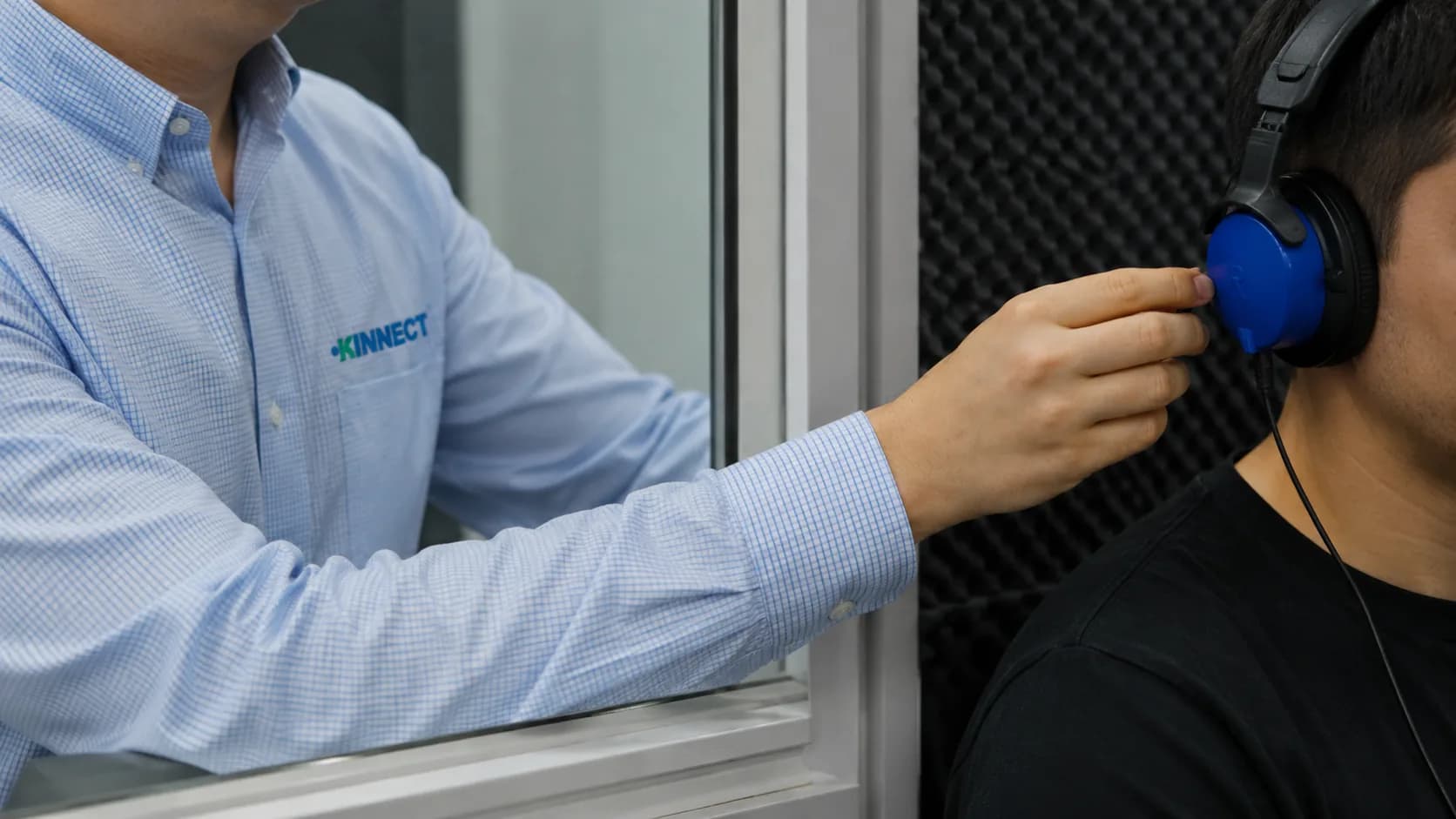
A short, structured 20-minute assessment per worker.
Designed to be quick and minimally disruptive, whether we're running the program through a clinic or onsite with access to a suitably quiet testing environment at your workplace.
- STEP 01
Quiet period check
We confirm the worker has had at least 16 hours away from occupational noise so the result reflects their true hearing baseline, not a temporary shift.
- STEP 02
Otoscopy & history
A brief ear examination and short history covering noise exposure, hearing protection use, prior ear conditions and any current symptoms.
- STEP 03
Pure-tone audiometry
Air-conduction thresholds across the audiometric frequencies, using calibrated equipment in a clinic sound-attenuating booth or onsite with access to a suitably quiet testing environment at your workplace.
- STEP 04
Result review & reporting
Threshold shifts are flagged, the worker is given immediate feedback, and individual and aggregated reports are returned to the employer.
Onsite or in clinic, whatever suits your workforce.
Same protocol, same standard, same reporting, delivered in the format that minimises disruption to your operation.
Onsite at your workplace
Our mobile audiometry teams come to you, ideal for high-volume programs, shutdowns, shift workforces or remote sites where pulling people offsite isn't practical. Onsite testing requires access to a suitably quiet testing environment at your workplace.
- Access to a suitably quiet testing environment required
- Designed for high-volume days
- Works around shift patterns
- Available regional & remote
In any KINNECT clinic
Walk-in audiometry for individual workers, smaller crews, or top-ups in between scheduled onsite programs, available nationally across our clinic network.
- Sound-attenuating booths in clinics
- Available in every KINNECT clinic
- Suits smaller crews & top-ups
- Same AS/NZS 1269.4 protocol
- Worker reports same-day
Explore our KINNECT office network.
Explore our complete owned-office network. Service availability varies by location, so contact us to confirm the right location for this service.
Queensland
New South Wales
Victoria
Western Australia
South Australia
Northern Territory
Defensible records, aligned to the standard.
Audiometry is one of the most heavily prescribed health monitoring tests in Australian WHS legislation. KINNECT’s program is built to deliver clean, defensible records that meet the standard you’re measured against.
All testing is conducted by trained Audiometric Officers using calibrated equipment, with clinical review and clear reporting back to the employer. Clinics use sound-attenuating booths; onsite testing requires access to a suitably quiet testing environment at your workplace, so your health monitoring obligations are visibly met.
- 01
AS/NZS 1269.4
Tests are performed by Audiometric Officers trained in the AS/NZS 1269.4 procedure for audiometric testing of occupational noise-exposed workers.
- 02
WHS health monitoring obligations
Helps meet employer obligations under WHS legislation to monitor the hearing of workers exposed to noise above the exposure standard.
- 03
Clinic booths & quiet onsite environments
Calibrated audiometers are used in sound-attenuating booths in clinics. Onsite testing requires access to a suitably quiet testing environment at your workplace.
- 04
Individual & aggregated reporting
Workers receive their individual result; employers receive aggregated reporting with any abnormal results clearly flagged for action.
Common questions from WHS & HR teams.
How often do noise-exposed workers need an audiometry test?
A baseline test is performed before (or as soon as practical after) a worker starts being exposed to occupational noise, followed by periodic monitoring, typically every two years, more frequently in high-exposure roles or when required by the regulator.
Can KINNECT come to our site?
Yes. Our mobile audiometry teams deliver onsite testing nationally, ideal for shutdowns, shift workforces and regional or remote sites. Onsite testing requires access to a suitably quiet testing environment at your workplace. Sound-attenuating booths are available in our clinics, not supplied for onsite testing.
Who performs the test?
Testing is performed by Audiometric Officers trained in the AS/NZS 1269.4 standard, with clinical oversight by KINNECT's in-house Occupational Health Doctors.
What reporting do we get back?
Workers receive their individual result on the day; employers receive a consolidated report covering all workers tested, with any abnormal results or threshold shifts clearly flagged for follow-up.
Other Health Monitoring services.
Audiometry is one part of a wider hazard-based health monitoring program. Pair it with other KINNECT services to cover your full hazard register.
Hearing Fit Testing
Personal attenuation rating testing to confirm hearing protectors actually work for each worker.
Learn moreRespirator Fit Testing
Quantitative and qualitative fit testing onsite or in-clinic, AS/NZS 1715 compliant.
Learn moreRespirable Crystalline Silica (RCS) Medicals
Silica-exposed worker monitoring including spirometry, chest imaging and physician review.
Learn morePeriodic Health Monitoring
Tailored periodic surveillance programs aligned to your hazard register.
Learn more
Get an audiometry program built around your workforce.
Tell us how many workers, where they are, and how you’d like the testing delivered. We’ll come back with a tailored quote and a plan that meets your WHS obligations.
Practical legislative guidance
Turn workplace exposure obligations into a clear next step.
Use these employer resources to understand health surveillance requirements, choose the right monitoring point and investigate exposure-specific considerations.
Health Surveillance Guide
Understand when health surveillance is required and how a program supports workplace controls.
Open resourceHealth Monitoring Types Guide
Compare baseline, periodic, post-exposure and exit health monitoring.
Open resourceHazardous Exposure Directory
Find monitoring considerations for workplace hazards and hazardous substances.
Open resource