My first year in workplace rehabilitation: What mentoring, peer support and the right program made possible
The field of workplace rehabilitation is complex and often receives little attention in university programs. Success, therefore, depends on receiving exceptional on-the-job training, mentoring and support. KINNECT has committed to fulfilling these needs for our graduates and those new to the field through a structured 12-month program.
The Workplace Rehabilitation Success Program begins as soon as a new graduate or new-to-industry recruit starts with KINNECT. It has been developed in-house to enable participants to gain essential knowledge and skills, forge valuable professional relationships, and lay the foundation for their long-term success.
We spoke to Nectaria Markellos, a Registered Psychologist and Workplace Rehabilitation Consultant from Sydney, about her experiences in the program and its impact on her practice and career.
What drew you to your area?
I’ve always been interested in helping people. For me, it started as being a helper friend – a really informal way of helping people. When I got to the end of Year 12, I thought, “How can I use the skills and interests that I’ve got and make a career of it? I had a couple of different ideas about what I wanted to do – maybe by becoming a criminologist or a social worker.
I had always had an interest in psychology but never seriously thought about pursuing it. I was accepted into a Bachelor of Arts program that included a core psychology program. I really enjoyed the core psychology subjects I took in my first year and then transferred directly into the psychology degree at the end of the year. And as they say, the rest is history.
What made you consider KINNECT for a graduate position?
I worked in administration at a medical centre while I was studying. A KINNECT consultant – who is now one of my colleagues – attended appointments with one of her clients there and she was always lovely and friendly.
Around that same time, I completed my master’s degree and began looking for internship opportunities, which I needed to complete to become a registered psychologist. I came across a job ad on SEEK; the name ‘KINNECT’ sounded familiar, and the advertised role seemed like a good opportunity.
I’ve always been interested in the idea of career counselling, and supporting high school students in making decisions about what to study and what to do with their future. This role [new employer services] was adjacent to that type of work, and based on my interactions with the KINNECT consultant in my previous job, I knew the company had a great work environment.
Did you know much about workplace rehab prior to joining KINNECT?
No. But I should say that there’s probably a bit of (undeserved) stigma around psychologists in workplace rehabilitation, and a belief that there’s really no work for us in workers’ compensation.
My knowledge of workplace rehabilitation was minimal; I knew there was a certificate of capacity, which means the client has been injured and either has some capacity to work or not. They would review that certificate with their doctor, and that was it.
I never knew there was someone behind the scenes helping them return to work, managing all those conversations with employers and other stakeholders. If you’re looking at people returning to new employment, there’s someone who’s helping the worker build skills and become job-seeking and independent.
How were you supported when you joined us?
I was supported by my Team Manager, but I also had another registered psychologist who mentored me fortnightly through the Workplace Rehabilitation Success Program. Plus, of course, I had the support of the wider NSW team.
One of the things about KINNECT that I just love, and I wanted from the beginning, is that the team is so close-knit that you can ask anyone for help. There’s no question too big or too small. And it’s not just the support of one person or someone in the same field as you (e.g., psychologists); your colleagues come from different backgrounds, so you can go to a physiotherapist or an exercise physiologist, who can offer a different perspective and assist in furthering your own knowledge.
For me, everything’s new, so being able to go to someone and run things past them has been so helpful. The support is unbelievable – there’s someone with you every step of the way. You’re here to learn, and they’re here to support you.
What was involved in the Workplace Rehabilitation Success Program? 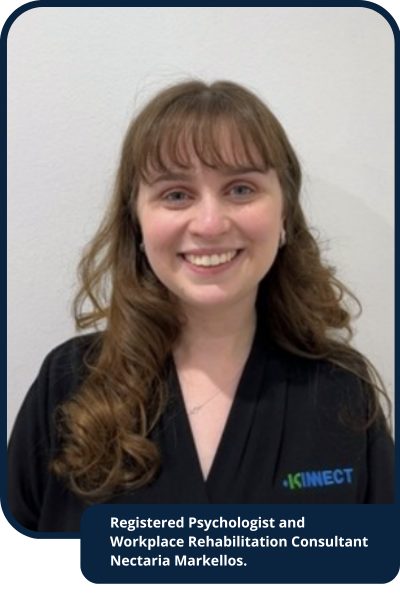
There were many Learning and Development (L&D) sessions on topics such as setting SMART goals, medical case conferences, and speaking with clients and employers. These were great because when you come into workplace rehabilitation, it’s like learning a different language altogether. You do learn a lot of these things on the job, but the L&D sessions are a little bit more tailored in terms of their teachings.
“The mentoring was invaluable because it was with a psychologist who supported me not just with the rehabilitation side of things but also in navigating the psychological side of the role, including aspects relating to completing my internship.”
We also had an amazing in-person celebration at the end of the year, where I got to meet everyone that I’d been learning with online during sessions throughout the year. I’d built really good connections with colleagues across different states, whom I go back to now and again to ask their opinion on something or even just to chat.
What were the most important things you got out of it?
Firstly, learning how to set SMART goals. I can’t tell you how profound that L&D session was. SMART goals are something that’s so simple, and you get some formal training in at university, so you think, “I know what a SMART goal is. I know how to develop one.” In the L&D program, they said, “Why don’t we start by asking the client what one of their goals is?” and I couldn’t believe I hadn’t thought of that. It’s so simple, but so profound in that moment when you’re caught up in learning a new job and trying to master various aspects of the role; it’s easy to forget the simpler things.
Another session on medical case conferencing was quite profound as well. There are things you can do to really boost a medical case conference and achieve good outcomes, such as reaching out to healthcare providers beforehand, for example, receiving feedback and recommendations to physiotherapists, exercise physiologists, or psychologists, and knowing how to use that information.
What’s so fulfilling about your role as a psychologist who works in workplace rehabilitation?
Getting to see the change that happens in people, because when people come to you, they really are at their most vulnerable. They’ve maybe just had their injury, and they’re so overwhelmed because the process is long and there are so many people involved in supporting them that may feel disoriented and unsure how all the pieces interact and come together to support them holistically.
I get to make an impact from the get-go, where I can say, “This is what I do. Let me help you. Let me make this as easy as possible for you.” I can work collaboratively with them and their treatment providers and put a good plan in place that sees them become comfortable with the process and more confident in themselves. I always say they haven’t lost their skills, abilities and knowledge; they just need some support for a little while to help them recognise the strength and confidence within themselves.
I’ve yet to come across a client who’s not grieving or going through some kind of loss, not just for their job or their identity, but for their autonomy to make decisions in their life. Suddenly, they’re thrust into a process that’s there to support them, but they’re feeling consumed by the various undertakings required of them. They can feel like they’ve lost their ability to make decisions for themselves, so I try to give a little of that back by helping them navigate it all and showing them how to navigate the system.
What are your goals for the future?
I feel like I’m still so new to everything. I just would love to keep going with rehabilitation and see where it takes me. It’s so diverse, and I feel that there’s still so much left for me to do and achieve in this space. I want to continue to grow my knowledge and skills.
If I look back to a year ago when I first started, I feel like a completely different person. I have had so many experiences and things that I thought I’d never be able to do; I’m now doing them like it’s second nature. But there are still so many instances where I have had new experiences, and there are new things to learn and do, which I enjoy.
At KINNECT, we don’t believe in throwing people in the deep end. We equip our graduates with the knowledge, tools, and support they need to excel from day one.
If you’re finishing an undergraduate or post-graduate degree in psychology, rehabilitation counselling, physiotherapy, occupational therapy or exercise physiology and are considering a career in workplace rehabilitation, apply now.