The term ‘psychosocially safe work environments’ refers to the mental health and wellbeing in relation to the social environment of a workplace. Recent studies indicate that job-related psychosocial hazards and vocational stress are becoming primary contributors to occupational illness and injury, and workers’ compensation claims.
In addition to business prosperity, employers have legal responsibilities under the model WHS Act and health care duties to manage workplace mental and psychosocial risk factors.
Benefits of a Psychosocially Safe Workplace
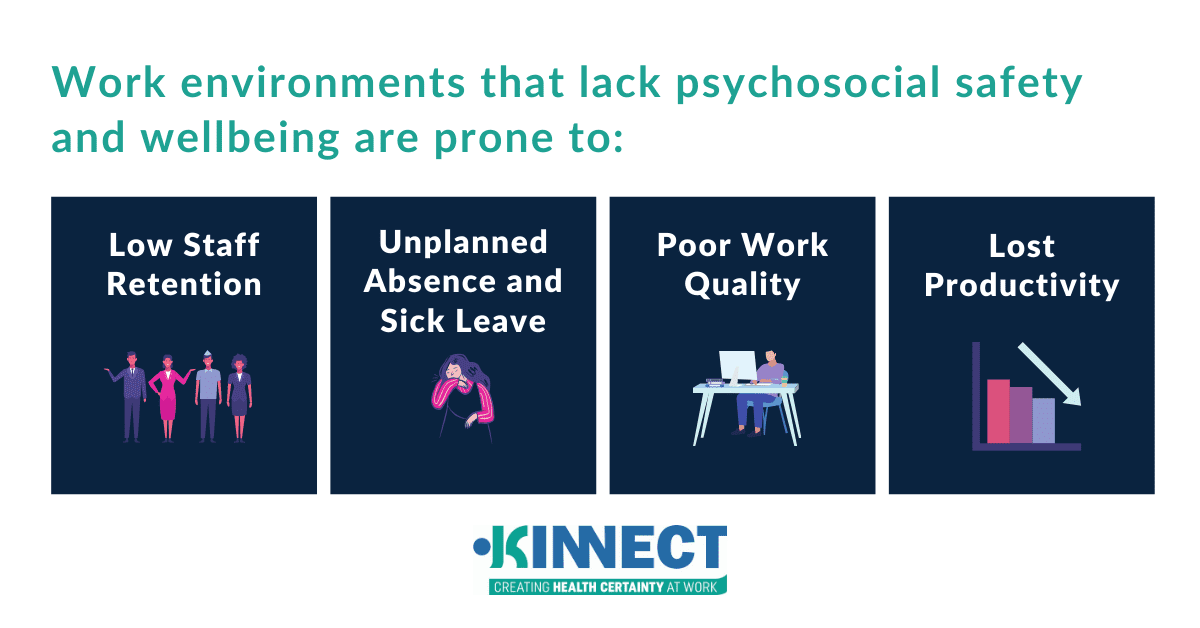
It makes good business sense to ensure the psychosocial wellbeing of a workplace – for the health and wellness of individual employees and the organisation as a whole. Work environments that lack psychosocial safety and wellbeing often see low staff retention rates, more unplanned absences and sick leave, presenteeism, poor work quality and lost productivity. Employers who develop and engage strategies for mental and psychosocial health in their workplaces benefit from:
- Improved productivity;
- Reduced costs related to absenteeism and high employee turnover;
- Decreased stress levels in individual workers;
- Improved workplace culture and morale;
- Increased worker loyalty and job satisfaction;
- Greater return on training investments;
- Saved time, energy and expenses associated with discrimination claims; and
- Elimination or reduction of industrial disputes or fines for breaching Workplace Health and Safety laws.
Factors affecting Psychosocial Health and Wellbeing
Several psychological and social factors impact the health and wellbeing of an organisation. Firstly, psychological and social support is vital for individual workers. Additionally, workplaces should foster a supportive environment and offer opportunities for colleagues and management to discuss mental health and well-being.
Your organisational culture lays the foundations for your business’s health, wellbeing, and social structure. Companies that work to improve and foster a positive organisational culture that prioritises mental and physical wellbeing create a more psychosocially safe work environment.
Other work-related risk factors that influence psychosocial health include workload, fatigue levels, work/life balance, respect and courtesy, recognition and constructive feedback, psychological safety, physical safety, protection from bullying or harassment, and clear expectations and leadership. The absence of psychological support, poor work culture and the aforementioned work-related factors can cause:
- Withdrawal behaviours and mental health issues;
- Conflict in the workplace (including workplace bullying);
- Strain (inducing headaches, fatigue, anxiety and burnout);
- Incidents, accidents and injuries;
- Psychological injury claims; and
- Poor return-to-work outcomes for physical claims.
Effectively Managing the Psychosocial Wellness of a Workplace
Under Work Health and Safety (WHS) law, employers are required to identify and establish work practices to address potential hazards, risks, and actions that may cause incidents in the workplace; this includes events affecting the mental health of current workers and those returning to work. Employers must actively work to eliminate or reduce such hazards and risks or face workers’ compensation claims.
Workplace systems, policies and training can be implemented to mitigate these issues and improve psychological and social health by monitoring work environment conditions and employees’ health (physical and psychological). These may include access to an employee assistance program or counsellor, training for new managers in conflict management and effective leadership practices, workload monitoring, and confidential procedures for reporting bullying or harassment. Senior management, in particular, is best placed to establish practices and procedures to develop a positive psychosocial culture, which will ultimately impact employees’ work experience.
How KINNECT can help
We understand how critical psychosocial safety is to your organisation’s success, and therefore offer a range of services from pre-employment through to exit, with programs and assessments designed to assist Australian workforces in developing a positive culture and a safe psychosocial environment.
Our standard pre-employment medicals, periodic health monitoring, and exit screening include industry-approved psychological and mental health questionnaires that can be customised to suit your workforce.
Mental Health and Wellbeing Training
Our program improves awareness and equips your workers with the capabilities they need to recognise and act on mental health risks. This can help create a culture of wellbeing and optimise the effectiveness of your existing initiatives.
Additionally, our sister company, KINNECT Training, offers the following programs to ensure proactive health outcomes in your workplace:
Resilience in the Workplace Online Course
The ability to cope well with pressure, adversity and uncertainty relies on developing a particular set of behaviours, thoughts and actions. Fortunately, anyone can learn these skills to increase their personal resilience. Run by our partners at KINNECT Training, this course teaches evidence-based methods to help individuals develop resilience in the workplace and in their personal lives.
Mind Support Online Course
Mental health is integral to wellbeing as it affects how we feel about our work, our performance and how we interact with others. Run by our partners at KINNECT Training, Mind Support aims to help your leaders and staff promote positive mental health and support those who need it.
Fatigue Management for Supervisors
KINNECT Training has developed a comprehensive Supervisor Fatigue Management Training Program that provides participants with an understanding of fatigue, including the causes, signs and symptoms, considerations and related consequences. This allows them to identify cases of fatigue and intervene before an injury occurs.
If you are concerned about the social and psychological health and safety of your workplace, please contact us today to discuss how our services can ensure the health of your business.
Fatigue Management for Workers
KINNECT don’t believe in death by powerpoint so our fatigue management training programs are interactive in nature and delivered on site. We’ll equip your workers with simple techniques they can use at home and work to minimise fatigue and obtain better quality rest to improve their health whilst reducing their risk of injury and illness.
References
Becher, H., & Dollard, M. Psychosocial Safety Climate and Better Productivity in Australian Workplaces. Canberra: Safe Work Australia. (2016). https://www.safeworkaustralia.gov.au/system/files/documents/1705/psychosocial-safety-climate-and-better-productivity-in-australian-workplaces-nov-2016.pdf
Mental health. Safe Work Australia. (2020).
https://www.safeworkaustralia.gov.au/topic/mental-health.
Siegrist J. Psychosocial work environment and health: new evidence. Journal of Epidemiology & Community Health;58:888. (2004).
https://jech.bmj.com/content/58/11/888
2010 Workers with Mental Illness: A Practical Guide for Managers. Australia Human Rights Commission. (2010).
https://humanrights.gov.au/our-work/1-mental-health-workplace#fn2
ABOUT US
SERVICES
QUICK LINKS
CONTACT US